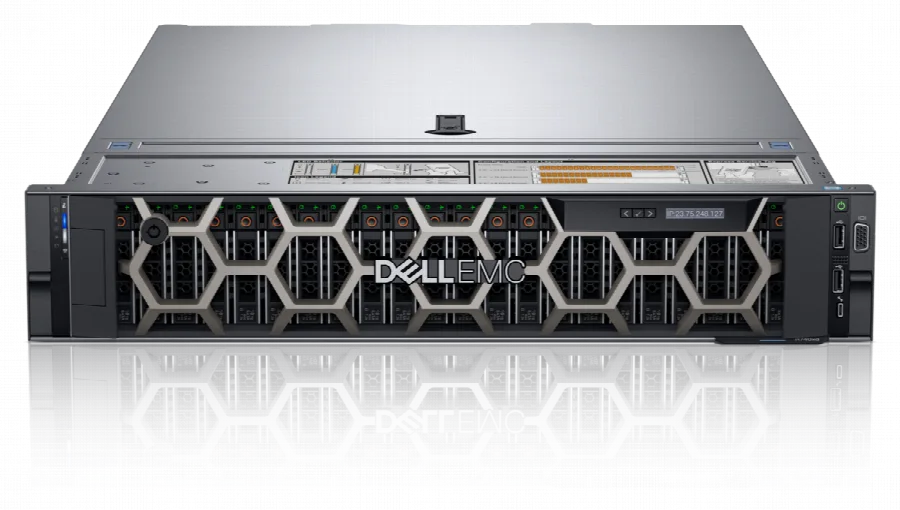
Dell PowerEdge R740 AI servers with NVIDIA Tesla V100 32 GB
Ready-to-use, tested 2U GPU servers based on the Dell PowerEdge R740 with 1–3 accelerators: NVIDIA Tesla V100 32 GB. Configurations provide 32 to 96 GB HBM2 of physical GPU memory and are prepared for local LLM inference, fine-tuning and conventional deep learning workloads. The server is supplied with complete GPU enablement, configured cooling, power supplies and a 12-month warranty.
Ready to run AI workloads.
up to 3× Tesla V100 32 GBup to 96 GB HBM2up to 336 TFLOPS Tensorup to 256 GB DDR4 ECC
Source: Dell Technologies. The photograph is the property of Dell.Choose a configuration
CONFIGURATIONS
Dell PowerEdge R740 AI server configurations
One platform in three hardware configurations.Each version uses the same fully equipped R740 base. They differ in processors, the number of V100 32 GB cards and system memory — additional GPUs can be installed later, as GPU power supplies and cabling are included from the outset.
Base configuration
Dell R740 AI Start — 1× Tesla V100 32 GB
32 GB HBM2 · 112 TFLOPS Tensor
Inference for models up to ~14B, prototyping, LoRA fine-tuning and a single AI service within a business.
PLN 17,300.00netPLN 21,279.00 including VATIndicative price
Maximum configuration
Dell R740 AI Max — 3× Tesla V100 32 GB
96 GB HBM2 · 336 TFLOPS Tensor
Configuration with 96 GB of physical GPU memory across three cards, intended for applications including larger models, longer context and running several services in parallel.
PLN 26,600.00netPLN 32,718.00 including VATIndicative price
B2B sales only, invoice with 23% VAT.
CUSTOM CONFIGURATION
Dell R740 AI server in a custom configuration
Custom configurations are quoted individually. The three variants shown are standard base configurations. If your project requires different components, we will prepare a quote for an R740 server tailored to your workload.
01
GPU cards
A different number of V100 32 GB cards or other accelerators from our range, e.g. Tesla P40 24 GB, Tesla P100 16 GB, Tesla V100 16 GB.
02
System memory
More or less DDR4 ECC memory than in the standard versions.
03
Drives
A different number and capacity of SSDs and a different RAID layout.
04
Processors
Other Intel Xeon Scalable models available to order.
Send details of your planned workload, model or environment. We will use these to propose a configuration and provide a quote, usually within one working day.
Dell PowerEdge R740 specification with GPU enablement
The common base for every configuration. The platform supports up to 3× dual-slot GPUs, with a complete set of risers, cooling, power supplies and GPU cables. Processors, system memory and GPUs depend on the version.
Server base
Model
Dell PowerEdge R740, 2U
RAID controller
Dell PERC H730P Adapter
Drive bays
16× 2.5" SFF
Network
2× 10GbE SFP+ + 2× 1GbE RJ45
Management
iDRAC9 Enterprise
Power supplies
2× 1600 W hot-plug
GPU enablement — complete equipment for 3× dual-slot GPUs
Risers
Dell Riser Config 4:
Riser 1A (MDDTD)
Riser 2A (J7W3K)
Riser 3A (DTTHJ)
Cooling
6× Dell 4VXP3 High Performance Fan
2× Dell C6R9H Low Profile / High Performance CPU Heatsink
Dell RFFDP GPU Air Shroud
GPU power
3× Dell 4VPD3 GPU power cable
GPU-to-GPU communication
PCIe 3.0 (the PCIe version of the V100 has no NVLink bridge)
Included and terms
Included
Dell ReadyRails, front bezel
Condition
Used, following technical qualification of each GPU card and certification of the complete server
Choosing the number of GPUs for your model and workload
Available GPU memory is one of the main factors determining the possible model size. The following is an indicative guide — exact requirements depend on factors including context length, batch size and the framework used.
Workload suitability by number of V100 32 GB cards
Workload
1× V100 32 GB
2× V100 64 GB
3× V100 96 GB
LLM inference 7–14BFP16, e.g. Mistral 7B; Qwen 14B in FP16 with a shorter context or at 8-bit
✓yes
✓yes
✓yes
LLM inference ~30B8-bit ~32 GB or 4-bit ~20 GB; FP16 ~60 GB for weights alone
Conventional DL: vision, detection, NLPdata-parallel training
✓yes
2 cards
3 cards
Several independent services at onceindependent workloads assigned to individual cards
-no
2
3
NVIDIA Volta architecture limitations: The NVIDIA Tesla V100 offers Tensor cores for mixed-precision FP16 computing and high CUDA performance in FP32. It does not support BF16 or FlashAttention 2. In PyTorch, vLLM or llama.cpp, models can run in FP16 or with quantisation — this operates reliably, and each card offers 32 GB of HBM2 memory.
READY TO USE
Server ready to run workloads.
01
Assembled and configured
Cards installed on GPU risers, connected with GPU power cables, beneath the GPU air shroud and with high-performance fans.
02
Ubuntu with test scripts
Preinstalled Ubuntu with the appropriate drivers and test scripts to verify the hardware on receipt.
03
Deployment support
We provide support in choosing a configuration and running your first workload.
CERTIFICATION
Server certification before dispatch — a full test run and unit documentation
Every server undergoes a full certification run before dispatch in the exact configuration in which it will be delivered — with the same processors, memory modules, drives, GPU cards, power supplies and network interfaces. Before load testing begins, the system automatically compares the detected configuration with the expected profile for the unit. The run covers the initial state, loads, final state and an automatic assessment of evidence completeness. An interrupted or incomplete run, or one that does not meet the certification criteria, cannot receive CERTIFICATION status.
01
Initial state
Before load testing begins, we check the system state reported by iDRAC, conformity of the detected configuration with the expected profile, firmware versions, BIOS profile, power supplies and power redundancy, network interfaces, RAID controller and a complete, newly collected hardware inventory with serial numbers. The actual PCIe link width and speed are also read for each GPU card from LnkSta. The run does not proceed to certification itself if the required input data is incomplete or the configuration does not match the unit’s profile.
02
Load testing
The server undergoes CPU burn-in, memory stability testing, SMART diagnostics and a self-test of every drive in a mode supported by that drive, controller and firmware, memory bandwidth measurement, CPU computing performance measurement, GPU computation tests and OpenCL/CUDA tests. Finally, a combined load is applied to the processors and all GPUs. Temperature, ECC errors and system events are monitored during the run.
03
Final state
After load testing, GPU ECC counters, kernel logs, hardware events and the state of key components are checked again and compared with the initial state. The final assessment has three independent layers: Hardware Result, evidence completeness (Evidence Pipeline) and Certification Result, which is the final classification of the run as certification, validation or failure. A certificate is issued only for a run that ends with a CERTIFICATION result.
Documentation supplied with the server
Certificate (PDF) — machine identity, configuration with serial numbers, list of completed stages with results and execution times, final classification of the run based on automatic certification rules, verification code.
Hardware inventory (JSON) — the machine’s state before testing, with serial numbers for processors, memory modules by slot, drives by bay, GPU cards and controllers.
Acceptance self-test — a standalone tool run after server delivery, without network access or access to the management controller. It confirms after delivery that all components are present and operational.
A full description of the certification run and resulting documents is available on a separate page.
Knowledge base: AI servers, Tesla V100 and local LLMs
Building an AI server involves more than choosing the number of GPUs. We have prepared technical materials on rack platforms, VRAM, the actual performance of used Tesla cards and the configuration of local AI models.
The choice of configuration depends primarily on model size, quantisation method, context length and the number of concurrent users. An R740 with one V100 32 GB is suitable, for example, for 7–14B models. Two or three cards allow larger models to be split across GPUs and increase the available memory budget.
How many NVIDIA Tesla V100 cards can be installed in the Dell R740 you offer?
Our Dell PowerEdge R740 configuration is prepared for up to three dual-slot NVIDIA Tesla V100 PCIe cards. The platform includes the appropriate risers, cooling, power supplies and GPU cabling.
Does 3× V100 32 GB provide 96 GB of shared VRAM?
Not automatically. Each V100 has its own 32 GB of HBM2. Three cards provide a total of 96 GB of physical GPU memory, but the model must be split across the cards by a framework or backend that supports multi-GPU operation.
Can the Dell R740 AI Start be upgraded to AI Pro or AI Max later?
Yes. From the outset, the platform includes the risers, cooling, power supplies and cabling required to support up to three dual-slot GPU cards. Upgrading primarily involves adding further GPUs and, if required by the target configuration, expanding or replacing system memory and processors.
Is the Tesla V100 32 GB suitable for local LLMs?
Yes. The V100 32 GB provides a large HBM2 capacity and high memory bandwidth. It is suitable, for example, for LLM inference in FP16 or with quantisation. However, the Volta architecture does not support BF16 or newer features available in subsequent GPU generations.
How are used Tesla V100 cards tested?
Each card undergoes qualification on a test bench before installation in the server: reading the unit’s persistent identifiers, memory testing, burn-in under load with thermal monitoring and verification of computational correctness. We issue a qualification certificate for each card, assigned to that unit. Details: how we check every used GPU accelerator.
How is the complete server certified?
The assembled server undergoes a separate certification run in its final shipping configuration. First, the system automatically checks the detected hardware against the expected profile for the specific unit, along with iDRAC state, BIOS, firmware, power, networking, RAID, memory and the PCIe parameters of each GPU card.
CPU, system memory, drive and GPU tests follow, along with a whole-system load test. On completion, the results are compared with the initial state, including ECC counters and error logs.
A certificate is issued only when both the hardware and the completeness of the evidence meet the certification procedure’s requirements. The server is supplied with a certificate bearing a verification code and a hardware inventory with serial numbers. Full description: AI server certification.
Qualification of an individual GPU card is a separate process and does not replace certification of the complete server: different tools, different cooling conditions and a different subject of assessment. Measurement results from the two processes should not be compared directly.
Does certification write anything to the server’s drives?
It does not write data or test patterns. We start the run from live media, with the system running in RAM. Certification does not install an operating system, partition or format drives, or perform tests that write user data or test patterns to the data area of the target drives. Drive condition is assessed using SMART and the self-test available for the drive type, firmware and RAID controller. The drive itself performs the self-test, and its firmware may update its own SMART diagnostic log in the process. If a full long self-test is not supported or its result cannot be obtained reliably through the controller layer, the procedure takes this into account in the final classification of the run.
Is the server supplied with an operating system?
Yes. The server is supplied with preinstalled Ubuntu, the appropriate NVIDIA driver and our test scripts for verifying hardware operation on receipt. These scripts constitute the acceptance self-test, a tool separate from certification: it confirms the presence and operation of components after delivery, does not assess performance and does not issue a certificate.
What warranty is provided for the AI server?
Standard Dell PowerEdge R740 AI configurations are covered by a 12-month warranty.
Do you need help choosing the number of GPUs?
Send details of your planned model or workload. We will prepare a configuration and quote, usually within one working day.